Cosmology & Contemporary Art — The Architecture of the Invisible
Cosmology and art share a common ambition: to interpret the structure of reality beyond immediate perception. While science seeks to understand the universe through measurement and theory, art approaches it through intuition, symbolic construction, and visual language.
In contemporary practice, this convergence becomes increasingly relevant. Artists are no longer limited to representation; they operate within conceptual systems that attempt to visualize the invisible — energy, time, expansion, and the dynamics of consciousness itself.
Rather than illustrating the cosmos, contemporary art constructs parallel structures that resonate with it, transforming perception into an active field of exploration.
The Universe as a Structural Model
Modern cosmology describes a universe defined by expansion, fragmentation, and interconnected systems. These same principles can be observed within advanced contemporary art practices, where composition reflects movement, tension, and transformation.
The artwork becomes a system rather than an object — a configuration of forces that echoes the behavior of cosmic structures. Geometry, rhythm, and spatial relationships function as visual analogues of universal processes.
This shift redefines the role of the artist: not as a creator of images, but as an architect of perceptual realities.
From Matter to Consciousness
One of the most compelling intersections between cosmology and art lies in the question of consciousness. If the universe is not only material but also informational, then perception itself becomes a central dimension of reality.
Contemporary artists increasingly explore this idea by constructing works that do not merely depict forms, but activate awareness. The viewer is not passive; they become part of the system.
In this sense, art operates as a bridge between matter and consciousness — a space where the internal and the cosmic converge.
Dan Aug — Cosmic Expressionism
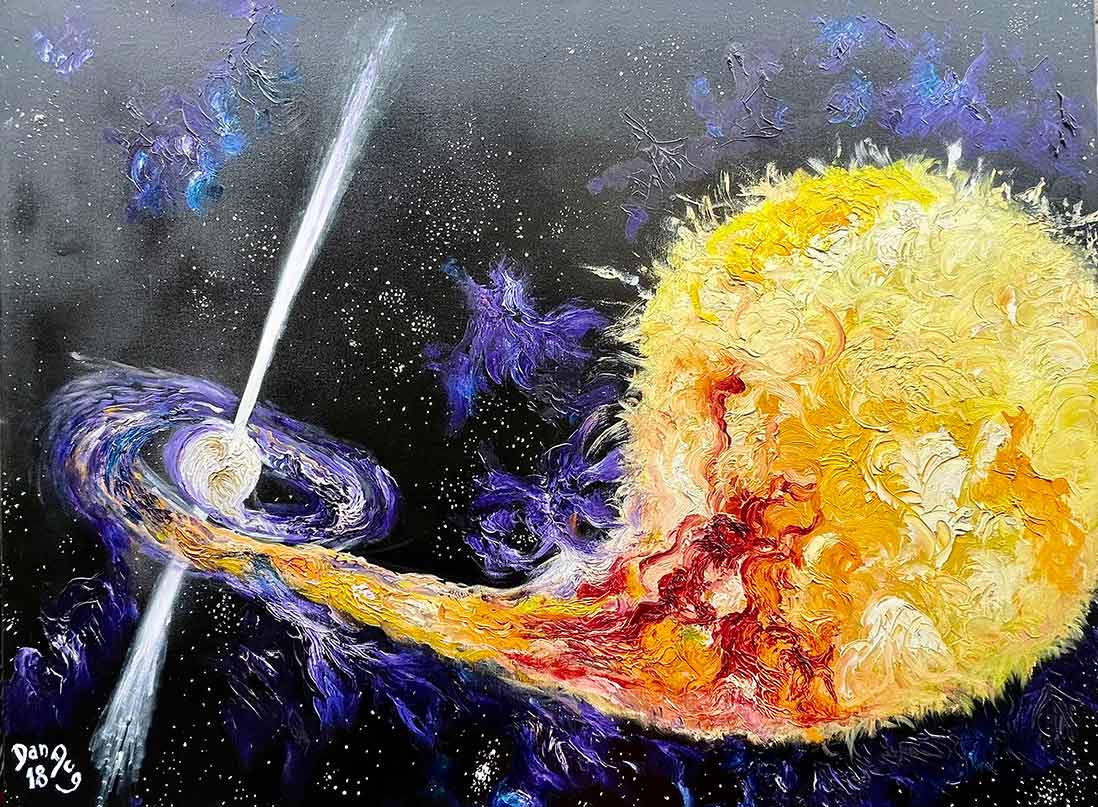
In the work of Dan Aug, cosmology is not referenced — it is embodied. His visual language can be understood as a form of cosmic expressionism, where each composition reflects dynamic systems of energy, transformation, and expansion.
Rather than depicting the universe, his work constructs it. Layers, textures, and structural tensions generate a field in which perception unfolds, inviting the viewer into an active relationship with the image.
This positions his practice within a broader international dialogue that connects art, science, and philosophy, situating his work at the intersection of contemporary visual research and cosmological thought.
Art Beyond Representation
The relationship between cosmology and art ultimately challenges the limits of representation. If reality itself is dynamic, multidimensional, and partially invisible, then art must evolve beyond static imagery.
Contemporary artistic practice increasingly functions as a system of inquiry — a method of exploring existence rather than describing it.
In this context, cosmology becomes not a subject, but a framework: a way of thinking, structuring, and perceiving the world.
Conclusion
Cosmology and contemporary art are converging into a shared field of exploration. Both seek to understand and articulate the nature of reality, each through its own language.
In the work of Dan Aug, this convergence becomes visible as a living system — a synthesis of intuition, structure, and cosmic awareness that expands the boundaries of artistic practice.