
Conceptual and Symbolic Foundations
In the life of an artist, certain experiences transcend biography and become symbolic thresholds. In 2002, after returning to Uruguay from the United States, Dan Aug entered one of those decisive moments. From his apartment on a very high floor overlooking the Montevideo Bay and the Río de la Plata, the daily spectacle of light shifting over the water became a silent apprenticeship. Each sunset refined his sensitivity to rhythm, atmosphere, and cosmic order.
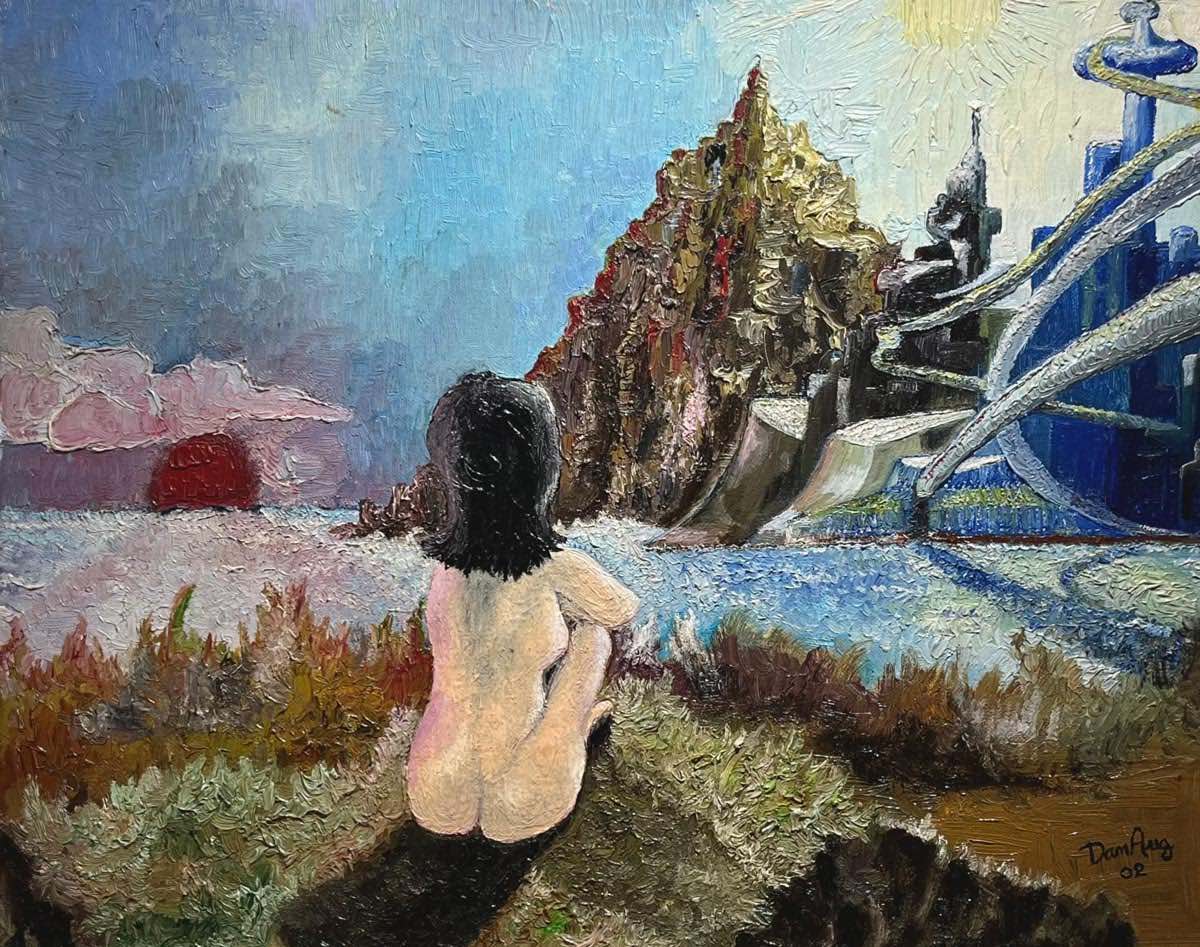
Within that ritual emerged the dream that would initiate the series—later embodied in the foundational artwork First Contemplation. A woman, seen from behind and endowed with archetypal presence, faced an unfamiliar, futuristic metropolis. Two suns illuminated the horizon. The artist’s interest in astrophysics—particularly binary systems—merged seamlessly with imagery evocative of ancient mythologies.
Simultaneously, Dan Aug’s growing engagement with the cosmology of Ancient Egypt began to inform his visual vocabulary. The dream thus became a point where contemporary consciousness met pharaonic metaphysics, and where symbolic memory fused with scientific intuition. It is from that convergence that the title Dream of a Night in Giza emerges—not as a geographic reference but as a conceptual anchor, marking the intersection between personal vision and ancestral geometry.
From that experience emerged a dream that fused personal vision with ancient archetypes. This convergence crystallized in First Contemplation, and from it arose the title Dream of a Night in Giza—not as a geographic reference, but as a symbolic coordinate linking memory, myth, and cosmic structure.
Giza as Conceptual Space
Giza functions here as an idea rather than a location: a place where origin myths, stellar order, and human consciousness intersect. It represents Zep Tepi—the first time—where meaning emerges from primordial chaos.
The Double Sun
The dual suns appearing in the original dream anticipate both ancient Egyptian solar multiplicity and modern astrophysical models. They become symbols of duality, reflection, and eternal recurrence.
Neferu: A Mediator Between Temporal Worlds
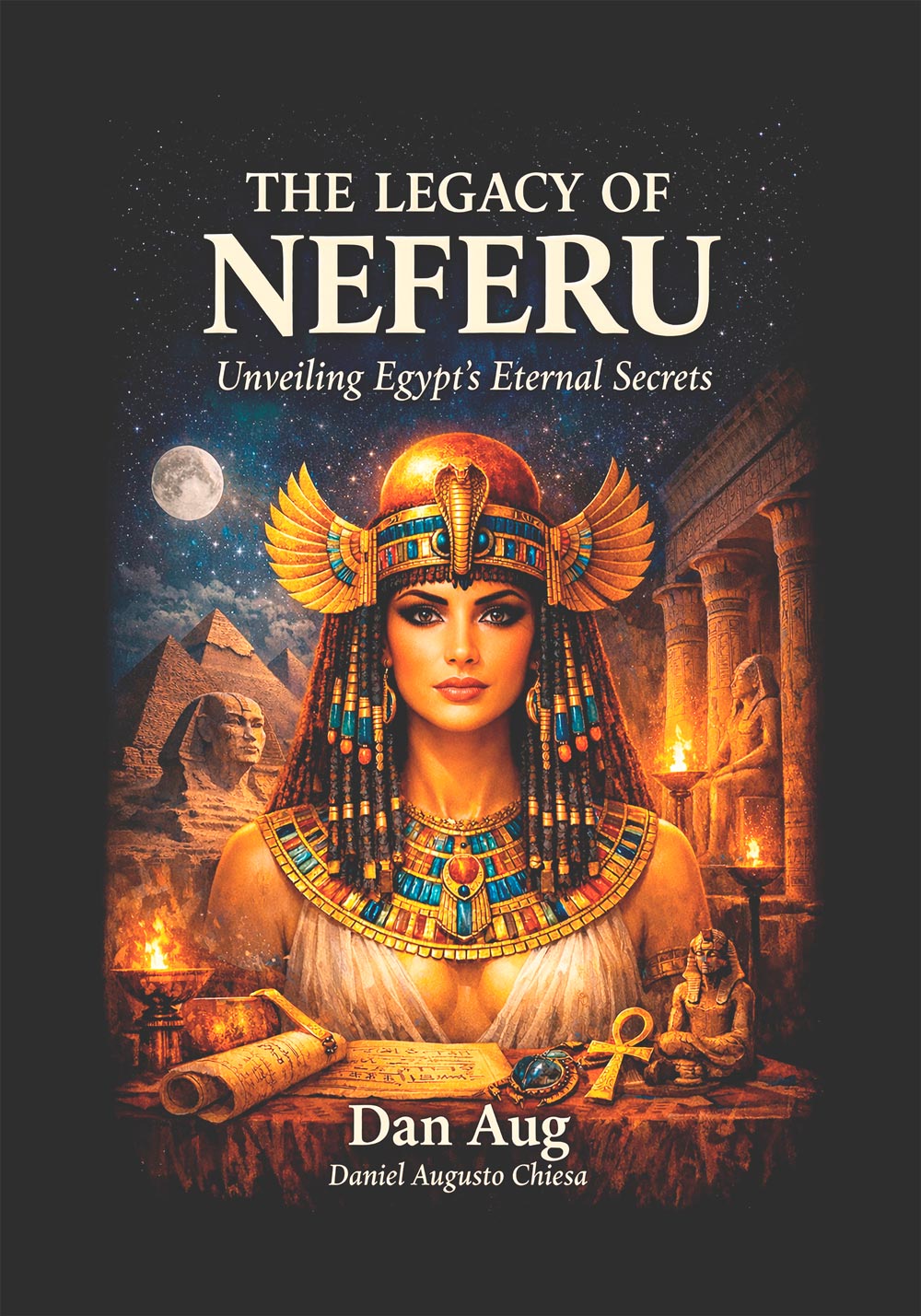
The female figure, later named Neferu, is less a character than an archetype. Her nudity evokes Middle Kingdom imagery where the exposed body signifies purity and metaphysical transparency. She stands between epochs, bridging pharaonic memory and speculative futurism, embodying a timeless spectator.
Conclusion
Through these conceptual pillars, Dream of a Night in Giza becomes more than a series title: it is the interpretive key to a visual cosmology. Across 46 artworks, Dan Aug extends the initial dream into a dialogue between ancient structures and speculative futures. The series revives an Egyptian intuition: that dreams can reveal truths about the cosmos.
The title ultimately names the space where the artist’s earthly experience merges with a larger symbolic memory—a threshold between Montevideo, Giza, and the celestial order—where human perception recognizes its own origin in light.