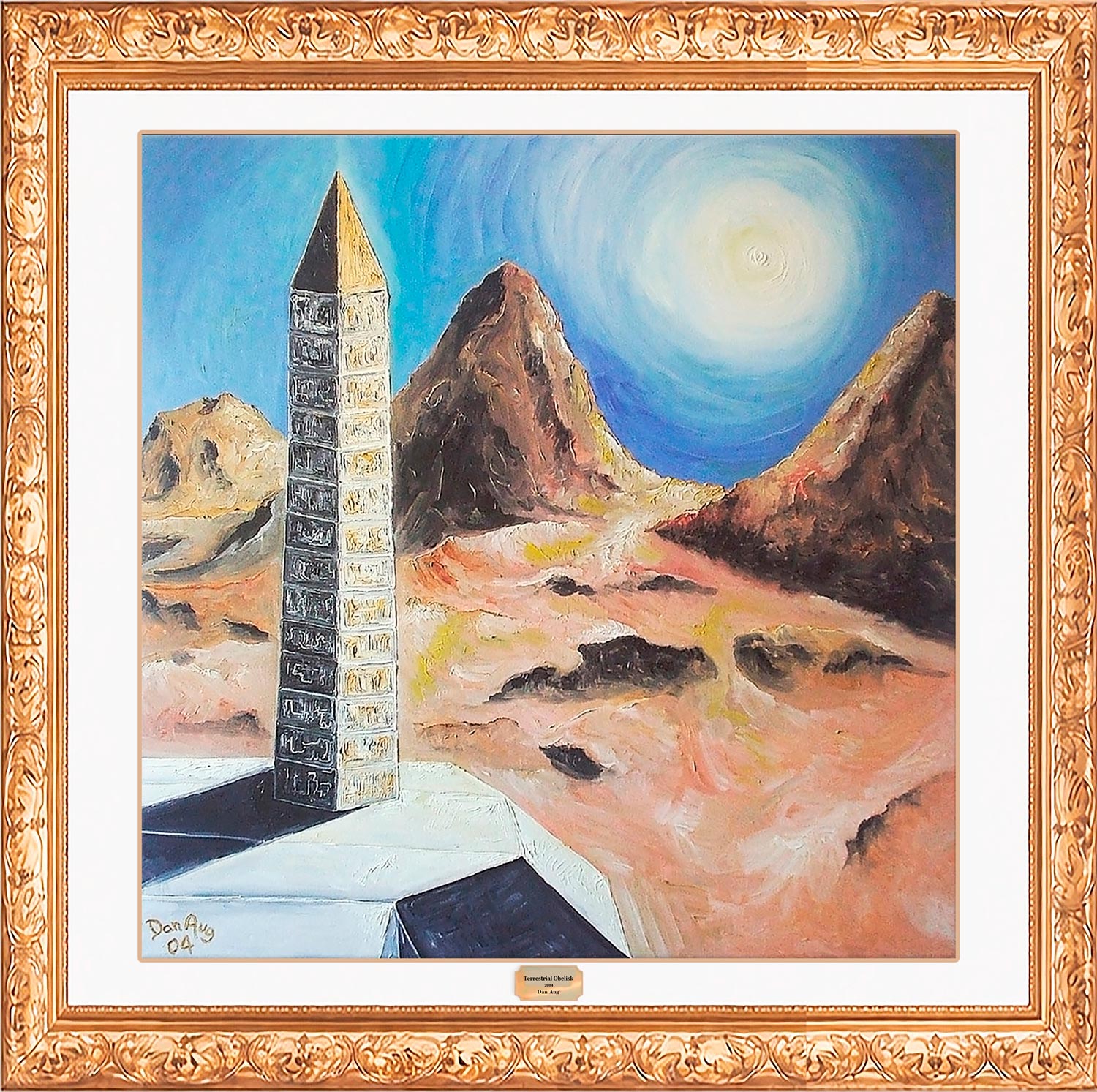
Terrestrial Obelisk marks a decisive moment of cognitive return within the journey of Neferu. After encountering the obelisk in the extraterrestrial domain of Thal-Ra, its reappearance on Earth is no longer perceived through the limits of cultural familiarity. Instead, it is understood as a universal structure — an axis that transcends geography and origin.
In contrast to the alien landscape of Thal-Ra, where the obelisk appeared as an anomaly, here it is embedded within the terrestrial order. Yet this apparent normality is deceptive: what has changed is not the object, but the gaze. The obelisk in Kemet reveals itself as a calibrated verticality — a vector of alignment between solar force and material ground, between time and permanence.
Executed in 2004, this oil on canvas (80 x 80 cm) operates through a refined symbolic economy. The composition stabilizes space, reintroducing horizon and gravitational coherence, while maintaining a latent metaphysical tension. The obelisk stands not as monument, but as instrument — an interface through which cosmic energy is inscribed into matter.
From a curatorial perspective, the work functions as a hermeneutic resolution. It completes the dialectic initiated in Obelisk in Thal-Ra, transforming estrangement into knowledge. The Egyptian obelisk is thus redefined: not a relic of a single civilization, but a localized manifestation of a broader, trans-cosmic symbolic system.