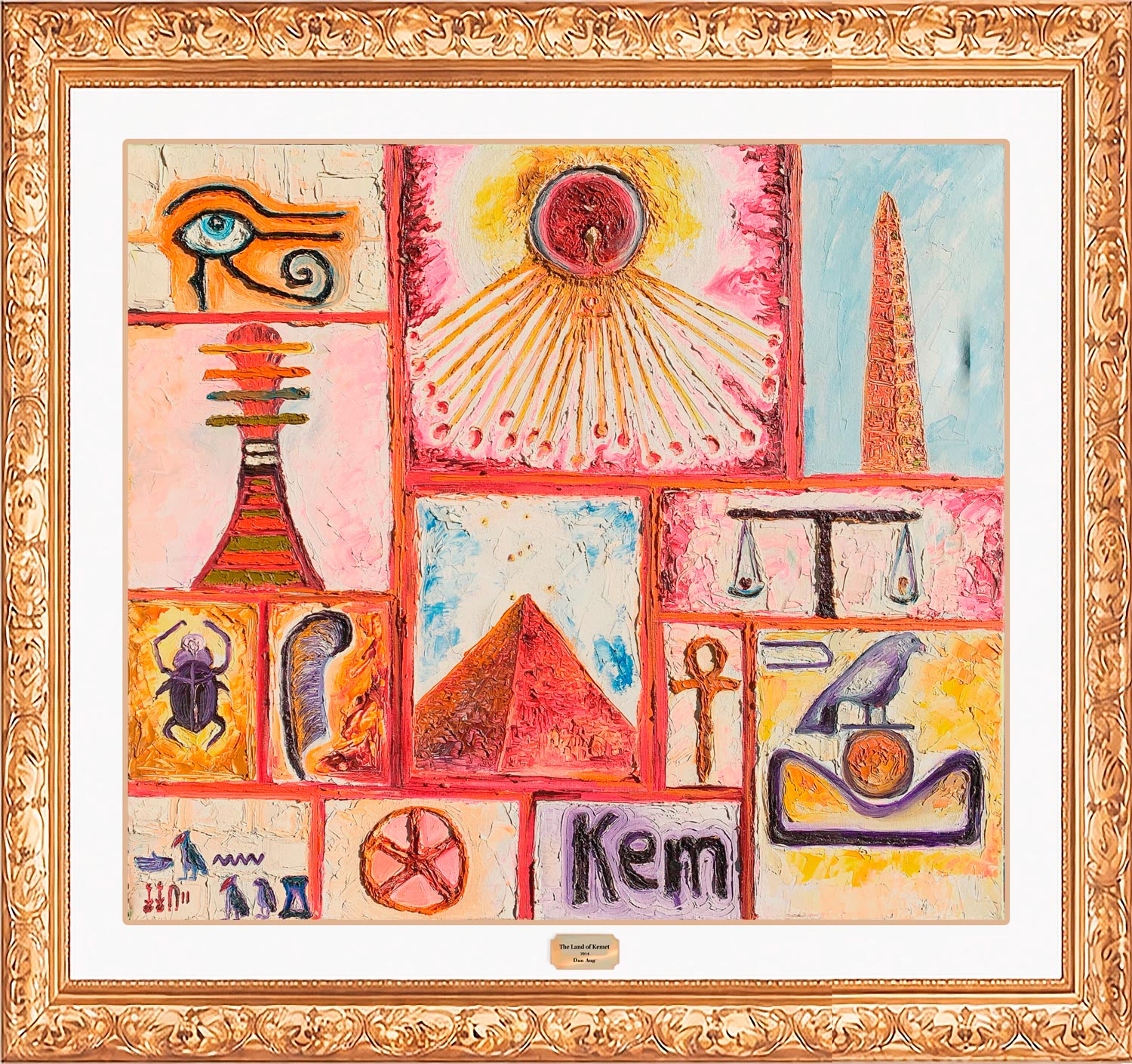
The Land of Kemet (2014) belongs to the intermediate period of Dan Aug’s artistic trajectory and presents a concentrated synthesis of essential symbolic elements drawn from ancient Egyptian cosmology. Executed in oil on canvas (60 × 60 cm), the work is distinguished not only by its iconographic density, but also by the presence of the artist’s signature rendered in hieroglyphic form—“Dan Aug 2014”—positioned beneath the composition, reinforcing the integration between authorship and symbolic language.
At the center of the work, the scarab (Khepri) emerges as a fundamental motif. In ancient Egyptian belief, the scarab embodies the principle of becoming, transformation, and solar regeneration, associated with the cyclical rebirth of the sun. Its presence introduces a dynamic concept of existence grounded in perpetual renewal.
Equally significant is the Eye of Horus (Wedjat), a symbol of protection, restoration, and perceptual integrity. Historically linked to healing and cosmic balance, the Eye functions here as a stabilizing counterpoint to the transformative force of the scarab.
Through the deliberate juxtaposition of these icons, the painting constructs a coherent symbolic field in which regeneration and protection coexist. The Land of Kemet thus operates not as a mere assemblage of motifs, but as a structured visual system that reactivates the metaphysical language of ancient Egypt within a contemporary visionary framework.