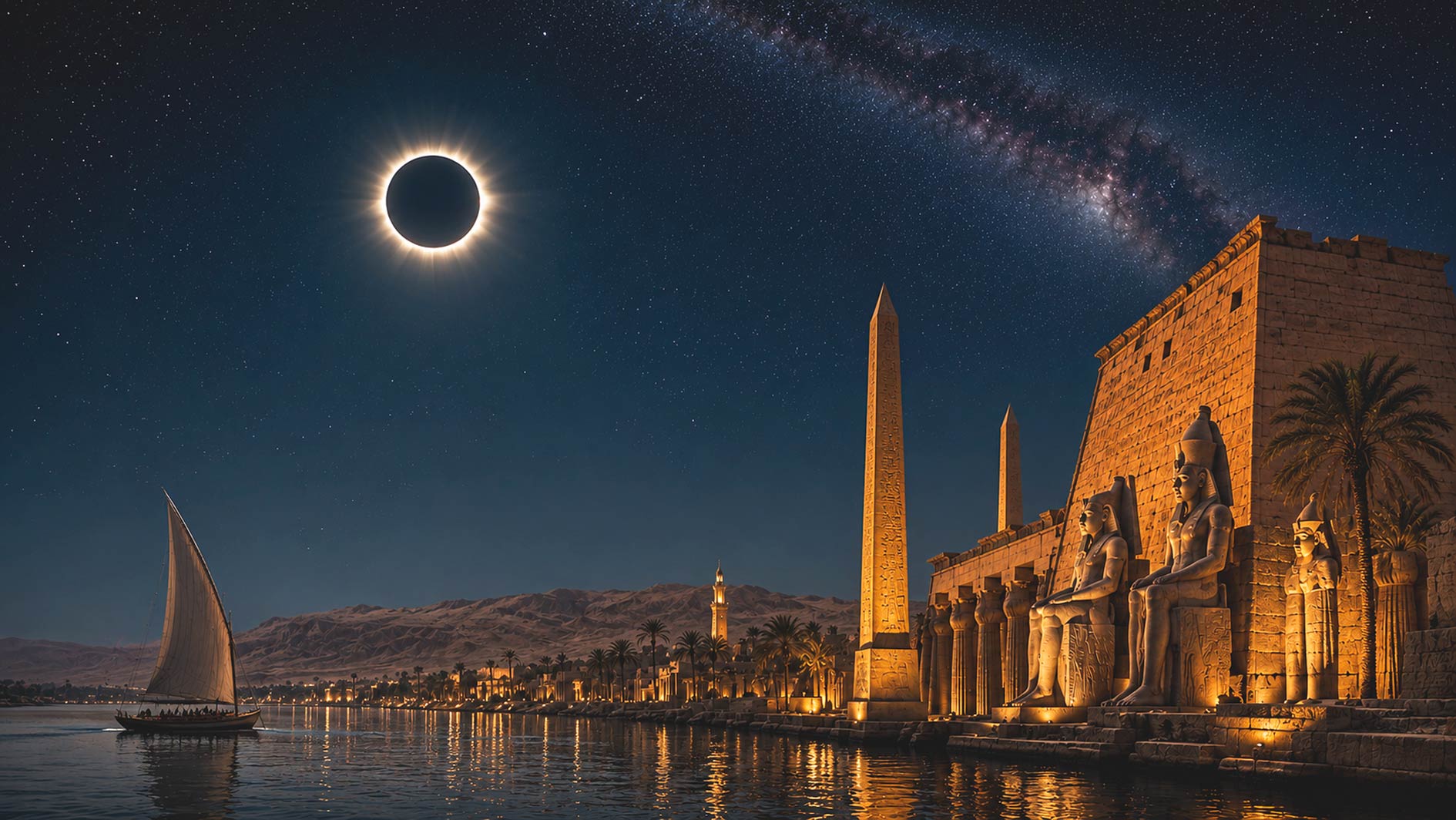
On August 2, 2027, daylight will briefly disappear above a vast corridor extending across several regions of the world. Among the places situated close to the path of totality is Luxor, Egypt — a landscape where the observation of the sky has been intertwined with architecture, religion, agriculture and human imagination for thousands of years.
For observers in and around Luxor, the event will be far more than an unusual astronomical spectacle. The setting itself gives the eclipse an extraordinary cultural dimension. The modern city occupies the territory of ancient Thebes, surrounded by some of the most significant monuments of Ancient Egyptian civilization.
Temples, tombs, monumental architecture, the Nile and the desert landscape create a setting in which an event governed entirely by celestial mechanics can also provoke questions about time, civilization and humanity's persistent desire to understand the universe.
A Celestial Alignment Above Luxor
A total solar eclipse occurs when the Moon passes directly between Earth and the Sun and its apparent size is sufficient to cover the bright solar photosphere. For observers located inside the path of totality, the sky darkens dramatically and the Sun's outer atmosphere — the corona — becomes visible around the black silhouette of the Moon.
The eclipse of August 2, 2027 has attracted particular attention because the path of totality crosses parts of North Africa and the Middle East, including southern Egypt.
The Luxor region is especially compelling because totality there is expected to last for more than six minutes — exceptionally long by the standards of total solar eclipses.
For a few minutes, an astronomical event calculated with extraordinary mathematical precision will unfold above a landscape shaped by a civilization that observed the Sun, stars and cycles of the sky thousands of years ago.
Ancient Egypt and the Sky
Astronomy was deeply connected with the rhythms of Ancient Egyptian civilization. Observations of the Sun and stars contributed to calendars, timekeeping, religious symbolism and the organization of ceremonial life.
The annual cycles of the Nile, the movement of celestial bodies and the progression of the seasons were part of a larger understanding of cosmic order.
The Sun occupied a particularly powerful position in Egyptian religious thought. Solar deities and solar symbolism appeared throughout different periods of Egyptian history, while temples and monumental structures frequently incorporated orientations connected with celestial and geographic phenomena.
The modern astronomical explanation of an eclipse is, of course, fundamentally different from ancient cosmological interpretations. Yet witnessing totality from this landscape creates an unusual dialogue between two ways of confronting the heavens: ancient symbolic interpretation and contemporary scientific understanding.
The Eclipse as Human Experience
Astronomy often begins with numbers: orbital periods, angular diameters, coordinates, distances and predictions.
But a total solar eclipse is one of those rare astronomical phenomena that transforms mathematical abstraction into an immediate physical experience.
The temperature can fall. The quality of light changes. The horizon takes on an unfamiliar appearance. Bright planets and stars may become visible. Animals can react to the sudden darkness.
And at the center of the sky appears the black lunar disk surrounded by the luminous solar corona.
No photograph completely reproduces the perceptual scale of this phenomenon. Totality is simultaneously astronomical, visual and emotional.
From Astronomy to Contemporary Art
My own relationship with astronomy has influenced my artistic practice for more than two decades.
Cosmology, stellar evolution, planetary exploration, time and the structure of the universe repeatedly appear throughout my work. Ancient Egypt later became another field of exploration — not as archaeological reconstruction, but as a symbolic landscape through which questions about consciousness, memory and civilization could be approached.
These ideas eventually developed into Dream of a Night in Giza , a contemporary art series inspired by Ancient Egypt, cosmology and the imagined dialogue between ancient and modern worlds.
Within the series, pyramids, temples, the Nile, primordial waters and celestial symbols are transformed through contemporary visual language: abstraction, geometry, chromatic fields, textures and layered material surfaces.
At its conceptual center is Neferu, a symbolic figure associated with memory, transcendence and the continuity of human questioning across time.
Why the Eclipse Inspired a Larger Project
As the 2027 eclipse approached, I began to think that the event offered an unusual opportunity to connect disciplines that are too often presented separately.
Astronomy can explain precisely why an eclipse occurs. Archaeology and Egyptology can reconstruct aspects of ancient civilization. Art can explore experiences and questions that cannot always be reduced to measurement.
From that idea emerged the Eclipse Convergence Platform , an independent international cultural initiative conceived around the 2027 eclipse in Egypt.
The concept is based on convergence: astronomy, contemporary art, Ancient Egyptian heritage, education, cultural exchange and international dialogue brought together around a real celestial event.
The Eclipse Convergence Platform
The Eclipse Convergence Platform — ECP — proposes the eclipse not simply as an observation event, but as the focal point of a broader multidisciplinary encounter.
Its astronomical dimension centers on the observation and interpretation of the total solar eclipse.
Its cultural dimension explores the historical and symbolic relationship between humanity and the sky, with particular attention to the extraordinary setting of Egypt.
The project also establishes a dialogue with contemporary artistic creation through Dream of a Night in Giza and with the philosophical narrative developed around Neferu.
Rather than suggesting that ancient and modern interpretations of the universe are equivalent, the project places them in conversation. Scientific knowledge tells us how the cosmos behaves. Cultural history reveals how civilizations have attempted to understand their place within it.
A Moment That Cannot Be Repeated
Every total solar eclipse is geographically unique.
The celestial mechanics that produce totality can be predicted centuries in advance, but the human circumstances surrounding each eclipse belong to a specific moment in history.
The August 2027 eclipse will occur only once across this particular landscape, at this particular moment, before this particular generation of observers.
For those who experience it from Luxor, the event may last only minutes.
Yet the setting connects those minutes with thousands of years of human history.
Perhaps this is what makes Luxor in 2027 so compelling: the eclipse does not merely place the Moon between Earth and the Sun. For a few minutes, it also places the present between the ancient past and the astronomical future.
Looking Toward August 2, 2027
During the months leading to the eclipse, interest in Egypt will increasingly come from astronomers, eclipse observers, photographers, researchers, travelers and people who simply want to witness one of nature's most extraordinary phenomena.
My interest is also in what can remain after those few minutes of darkness have passed.
An eclipse can become a point of departure for education, artistic creation and cultural dialogue.
Luxor offers an exceptional setting for that conversation because few places on Earth embody so visibly the long relationship between human civilization, time and the sky.
On August 2, 2027, the shadow will arrive, cross the landscape and disappear.
The astronomical event will end.
The questions it inspires do not have to.