Visual Thinking & Contemporary Art Where Egyptian Symbolism, Cosmology & Contemporary Art Converge
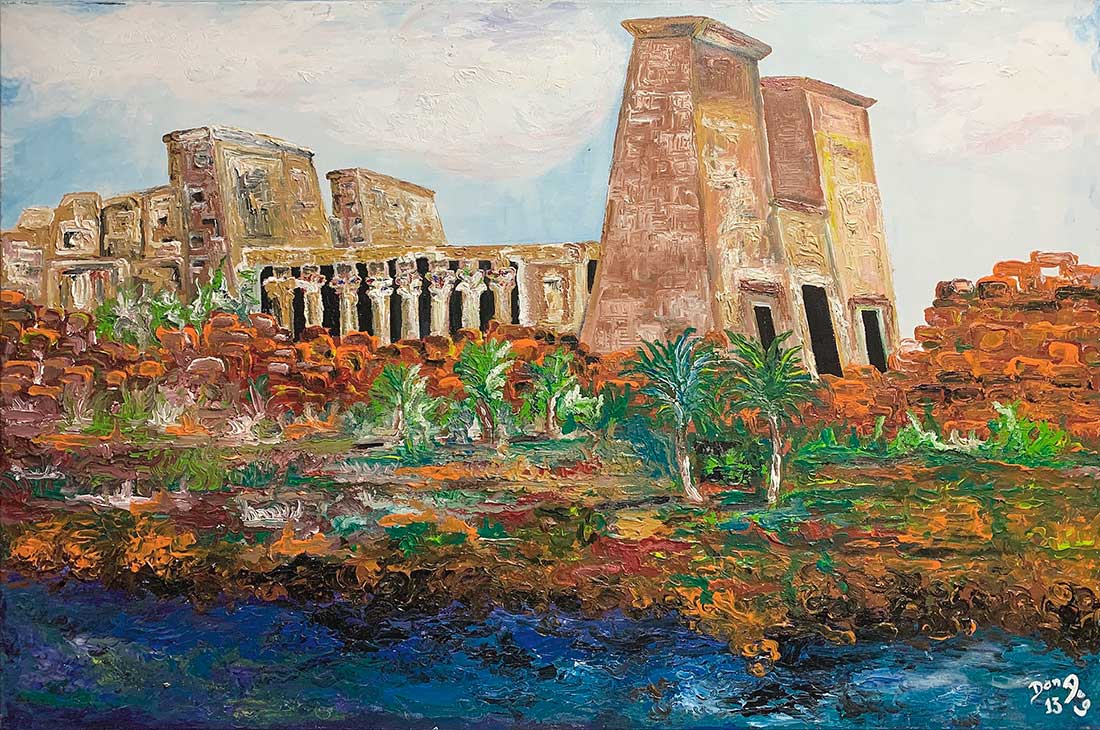
Ancient Egypt and Contemporary Art — The Vision of Dan Aug
Ancient Egypt remains one of the most profound and enduring sources of symbolic intelligence in the history of human creativity. Its visual language — constructed through geometry, myth, and cosmological structure — continues to resonate within contemporary artistic practices across Europe, the United States, and globally interconnected cultural contexts.
Rather than existing as a closed chapter of the past, Egyptian civilization persists as an active system of meaning — a conceptual architecture through which reality, consciousness, and transformation can be interpreted. In this sense, contemporary art does not simply reference Egypt; it reactivates it.
Within this framework, artists today engage Egyptian symbolism not as ornament or historical citation, but as a structural language capable of articulating the invisible — a language that bridges matter and perception, time and eternity, the human and the cosmic.
Symbolism as a Universal Structure
The Egyptian civilization developed one of the most sophisticated symbolic systems ever constructed. Every gesture, proportion, and compositional decision operated within a coherent metaphysical order, where visual form functioned as a carrier of knowledge rather than decoration.
This symbolic system was not illustrative — it was operative. It allowed the articulation of invisible principles: transformation, continuity, duality, and transcendence. In contemporary art, this logic re-emerges as artists seek to move beyond representation and toward structural meaning.
As a result, Egyptian-inspired visual language continues to gain relevance within international artistic discourse, particularly in European exhibition circuits and global platforms such as the Florence Biennale.
Cosmology and the Architecture of Reality
At the core of Egyptian thought lies a highly developed cosmological vision. Concepts such as cyclical temporality, emergence from chaos, and the continuity between life and death reveal a refined understanding of existence that resonates strongly with both contemporary physics and philosophical inquiry.
Today, artists increasingly operate within similar questions: how to represent what cannot be seen, how to translate consciousness into form, and how to construct images that do not describe reality, but generate it.
Within this context, Egyptian cosmology becomes not a reference, but a framework — a structural matrix through which art, science, and metaphysics converge into a unified field of exploration.
Dan Aug — Between Symbol and Consciousness
In the work of Dan Aug, Egyptian symbolism undergoes a process of transformation rather than replication. His visual language operates within a field that could be described as cosmic expressionism, where each composition functions as both image and system — a structure that reflects the internal architecture of consciousness as well as the generative patterns of the universe.
Rather than quoting historical motifs, his work absorbs and reconfigures symbolic principles into contemporary visual dynamics. Geometry becomes movement, myth becomes structure, and composition becomes a field of interaction between perception and meaning.
This positions his practice within an international dialogue that connects Europe, the United States, and Egypt — not geographically, but conceptually — through a shared inquiry into the nature of existence and representation.
👉 Explore Dan Aug and the Egyptian Connection
Art as a Bridge Between Civilizations
The dialogue between ancient Egypt and contemporary art reveals a fundamental truth: artistic expression transcends time. The same questions that motivated Egyptian creators — origin, transformation, infinity — continue to define human inquiry today.
Through this continuity, art becomes a bridge between civilizations. It connects past and present, myth and science, material reality and consciousness. In this sense, contemporary artists who engage with Egyptian symbolism are not looking backward — they are extending a conversation that has never ended.
This global relevance explains why Egyptian-influenced contemporary art continues to gain recognition in international exhibitions, academic discourse, and digital platforms.
Conclusion
Ancient Egypt continues to shape contemporary artistic language in ways that are both subtle and profound. Its symbolic and cosmological foundations provide a framework through which modern artists can explore the deepest dimensions of existence.
In the work of Dan Aug, this influence becomes a living force — a dynamic integration of ancient wisdom and contemporary vision. It is not a return to the past, but an expansion toward a more unified understanding of art, science, and consciousness.