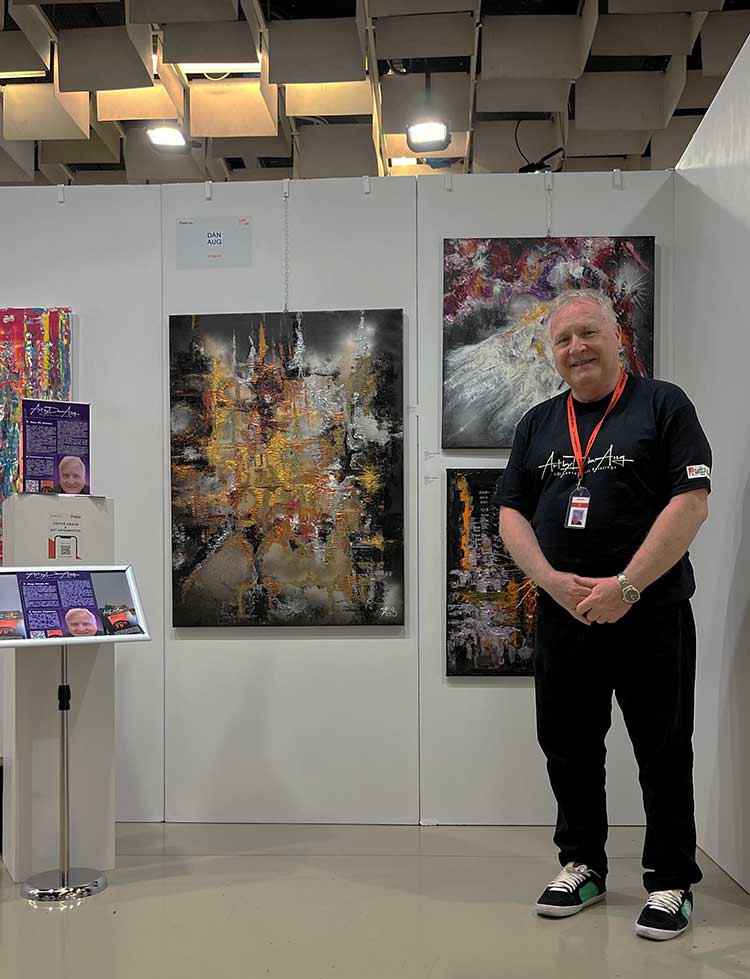
Florence Biennale 2023 — Dan Aug at the Intersection of Universal Art and Scientific Thought
In 2023, Dan Aug was selected to participate in the XIV Florence Biennale, one of the most significant platforms in the international contemporary art landscape. This milestone should not be understood merely as an exhibition within a global circuit, but rather as a critical inflection point in his trajectory — a direct encounter with the historical core of Western art and, simultaneously, with the scientific foundations that redefined humanity’s understanding of the universe.
Florence is not simply a city; it is an active symbolic system. It is the place where art ceased to function solely as representation and became a form of knowledge. Here, painting, sculpture, and architecture aligned with mathematics, physics, and empirical observation. The Renaissance did not merely transform aesthetics — it restructured the very framework through which reality itself is perceived.
To present work in Florence is, therefore, not only to exhibit — it is to enter into dialogue with centuries of accumulated thought.
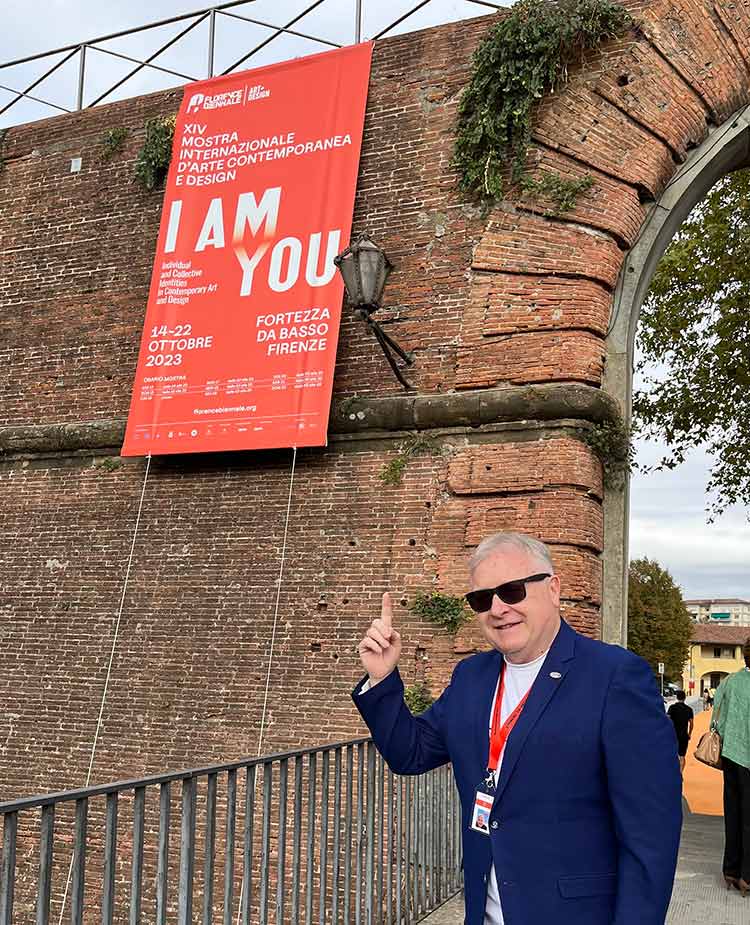
The Fortezza da Basso — A Field of Global Convergence
The Florence Biennale takes place within the Fortezza da Basso, a Renaissance architectural structure that now hosts some of the most advanced expressions of contemporary artistic thinking. This juxtaposition is not incidental; it is structural.
Within this space, artists from across the world converge not merely to display works, but to position conceptual frameworks. The Biennale operates as a dynamic field in which differing understandings of art, matter, and perception intersect and interact.
In this context, Dan Aug’s work emerges from a distinctive position — not as stylistic production, but as a conceptual system. His practice aligns with one of the enduring pursuits of art history: the attempt to render the invisible, to construct images that function as cognitive and perceptual structures.
It is here that his visual language — which may be defined as a form of “cosmic expressionism” — finds a coherent environment. Florence, after all, is not only heritage; it is an ongoing laboratory of thought.
Florence — The Epicenter of Scientific Renaissance
To speak of Florence is to invoke a historical moment in which art and science were inseparable. Figures such as Leonardo da Vinci embodied a synthesis between empirical observation and aesthetic creation.
Yet within this intellectual ecosystem, one figure becomes central to the scientific dimension of this experience: Galileo Galilei.
Galileo did not simply advance astronomy; he redefined humanity’s position within the cosmos. His work introduced an epistemological rupture that permanently transformed the relationship between perception and truth.
For an artist whose practice engages with cosmological structures, this encounter is not anecdotal — it is foundational.
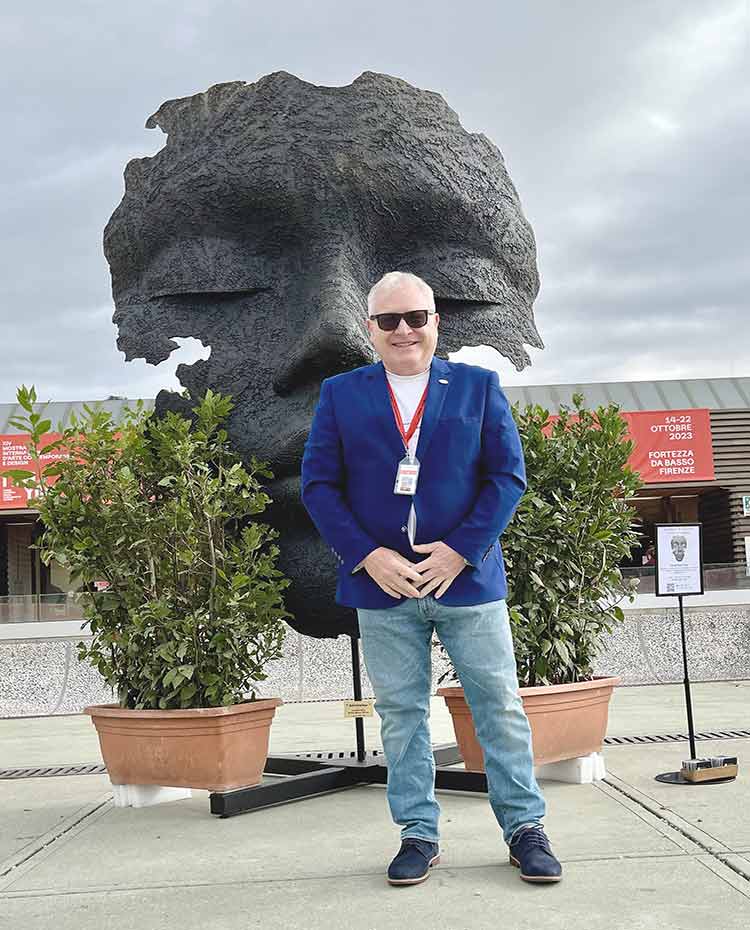
The Galileo Museum — Science as Revelation
The visit to the Galileo Museum becomes a pivotal moment within this trajectory. It is not merely a collection of historical instruments, but a space where devices that transformed human perception of the universe are preserved.
Telescopes, armillary spheres, measurement systems — each object embodies a materialization of thought. These are not passive tools; they are instruments of revelation.
In this sense, a profound correspondence emerges between science and art. Both operate toward a common objective: making the invisible visible.
The divergence lies in methodology — not in intention.
For Dan Aug, this encounter reinforces a conceptual axis already present within his work: the understanding that reality is not given, but constructed through systems of representation.
Art and Cosmology — A Unified Language
If the Renaissance enabled a comprehension of the world through proportion and geometry, contemporary thought demands new structures to engage with the complexity of the universe.
It is precisely here that art re-enters into dialogue with science.
Modern cosmology raises questions that resonate directly with artistic practice: What is space? What is time? How can that which cannot be directly perceived be represented?
Within this intersection, Dan Aug’s work does not function as illustration, but as system. His compositions operate as maps — structures that attempt to organize the intangible.
This positions his practice within a lineage that connects directly to the Renaissance spirit, yet extends it into a contemporary dimension.
An Artist Confronting Universal Art
To participate in the Florence Biennale is to confront not only an audience, but the entire historical continuum of art itself. References are not optional — they are inherent.
Within this framework, Dan Aug’s experience can be understood as a process of alignment — not with a movement or stylistic trend, but with a far broader tradition: art as a tool of knowledge.
Florence functions as a catalyst. It compels positioning. It demands clarity regarding the origin and intention of artistic production.
And within this context, his work emerges as part of a question that has traversed centuries: Can art reveal the structure of the universe?
Conclusion
The XIV Florence Biennale was not merely an exhibition for Dan Aug. It represented a point of convergence between history, science, and contemporary creation.
A moment in which artistic experience expands through direct contact with the legacy of the Renaissance and with figures such as Galileo, whose influence continues to shape our understanding of the cosmos.
Within this intersection, art ceases to be object and becomes instrument — language — system.
And it is precisely within this territory, between the visible and the invisible, that Dan Aug’s work finds its position.