What Does “The Big Crunch” Mean? A Cosmic Interpretation Through Abstract Art
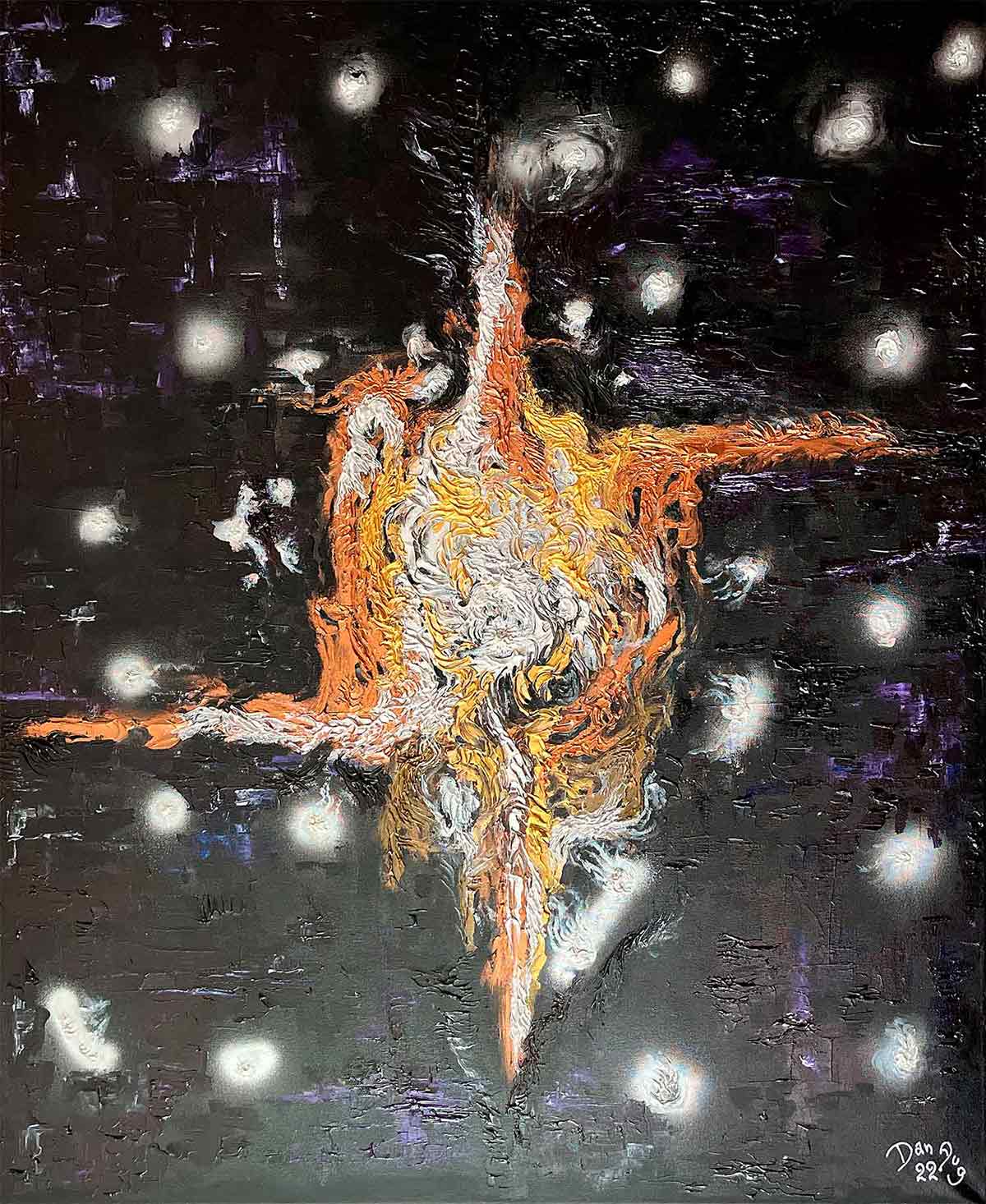
The Big Crunch is one of the most compelling and philosophically charged theories about the ultimate fate of the universe. It suggests that the current expansion of space — initiated by the Big Bang — could eventually slow down, stop, and reverse. In such a scenario, all matter, energy, galaxies, light, and even the fabric of space-time itself would begin collapsing inward, converging toward a final singularity.
This idea is not merely scientific. It is deeply existential. It questions permanence, direction, and the illusion of infinite expansion. It implies that everything that exists is part of a cycle — that growth inevitably contains the seed of contraction.
In this abstract artwork, Dan Aug transforms that theoretical and philosophical framework into a visual language. The painting does not attempt to depict the universe literally. Instead, it captures the sensation, tension, and inevitability of collapse — the invisible moment where expansion reaches its limit and begins to fold inward.
The Universe in Reverse
If the Big Bang represents explosion, birth, and outward movement, the Big Crunch represents the opposite vector: implosion, return, and concentration. It is the universe moving backward, retracing its own steps, collapsing its own history into a single point of density.
The artwork expresses this reversal through directional tension. Visual elements appear to converge rather than disperse. Instead of radiating outward, forms suggest inward motion — a gravitational pull that cannot be resisted. This creates a psychological effect on the viewer: a sense of being drawn into the composition rather than observing it from a distance.
Layered textures reinforce this concept. Each layer can be interpreted as a phase of cosmic history — accumulated, compressed, and ultimately forced into coexistence. The absence of empty space is intentional: it reflects a universe where separation no longer exists.
Density, Energy and Compression
One of the most critical aspects of the Big Crunch theory is the idea of increasing density. As the universe contracts, distances shrink, temperatures rise, and energy becomes more concentrated. The painting mirrors this through visual density and structural intensity.
There is no visual rest. No neutral zone. Every part of the composition carries weight. This saturation creates a sense of pressure — as if the canvas itself is reaching a limit. The viewer does not simply see collapse; they feel it.
Color plays a fundamental role in this perception. Dark tonalities dominate, but they are not empty or passive. They are charged, active, and heavy. They suggest not absence, but accumulation — matter and energy compressed beyond equilibrium.
This approach aligns the artwork with physical principles while remaining entirely abstract. It does not illustrate physics; it translates it into sensation.
Abstract Art as Cosmic Language
There is no photograph of the end of the universe. There is no direct visual reference for cosmic collapse. This is where abstract art becomes essential. It provides a language capable of expressing what cannot be seen.
Through rhythm, contrast, and composition, the painting constructs a non-verbal narrative. It invites interpretation, but also imposes a certain emotional direction. The viewer is not told what to think — but is guided toward a specific experiential state.
This is the strength of abstraction: it operates beyond representation. It engages perception, intuition, and internal imagery. In the context of cosmic phenomena, this becomes especially powerful, because it allows art to operate in the same conceptual space as theoretical physics.
Collapse as Transformation
The Big Crunch is often interpreted as an ending. However, within many cosmological models, it is also a beginning. The collapse could lead to another Big Bang — another cycle of expansion. In this sense, destruction and creation are not opposites, but phases of the same process.
The artwork reflects this ambiguity. While the dominant sensation is contraction, there is also a latent sense of potential. Compression implies stored energy. And stored energy implies release.
This duality gives the piece conceptual depth. It is not only about the end of the universe. It is about cycles, inevitability, and transformation. It suggests that collapse is not failure — it is transition.
Philosophical Interpretation
Beyond cosmology, the Big Crunch can be understood as a metaphor. Systems expand — civilizations, ideas, personal identities — but they also contract. Growth is not linear. It is cyclical.
In that sense, the painting operates on multiple levels. It can be read as:
– A representation of the universe
– A reflection on entropy and order
– A metaphor for psychological or emotional compression
– A commentary on cycles of creation and destruction
This multiplicity is intentional. It allows the artwork to exist simultaneously in scientific, philosophical, and emotional dimensions.
Digital Presence and Conceptual Continuity
This piece is part of a broader body of work exploring abstract representations of unseen realities. It aligns with a consistent artistic investigation into energy, structure, and transformation.
For a deeper exploration of related works and concepts, you can navigate through the following pages:
Official Website
Art Blog & Interpretations
Artworks & Editions
Contact & Inquiries
Explore the artwork: