The Thinking Silence A Cosmological Essay on Life and Consciousness | Philosophy, Universe and Human Perception
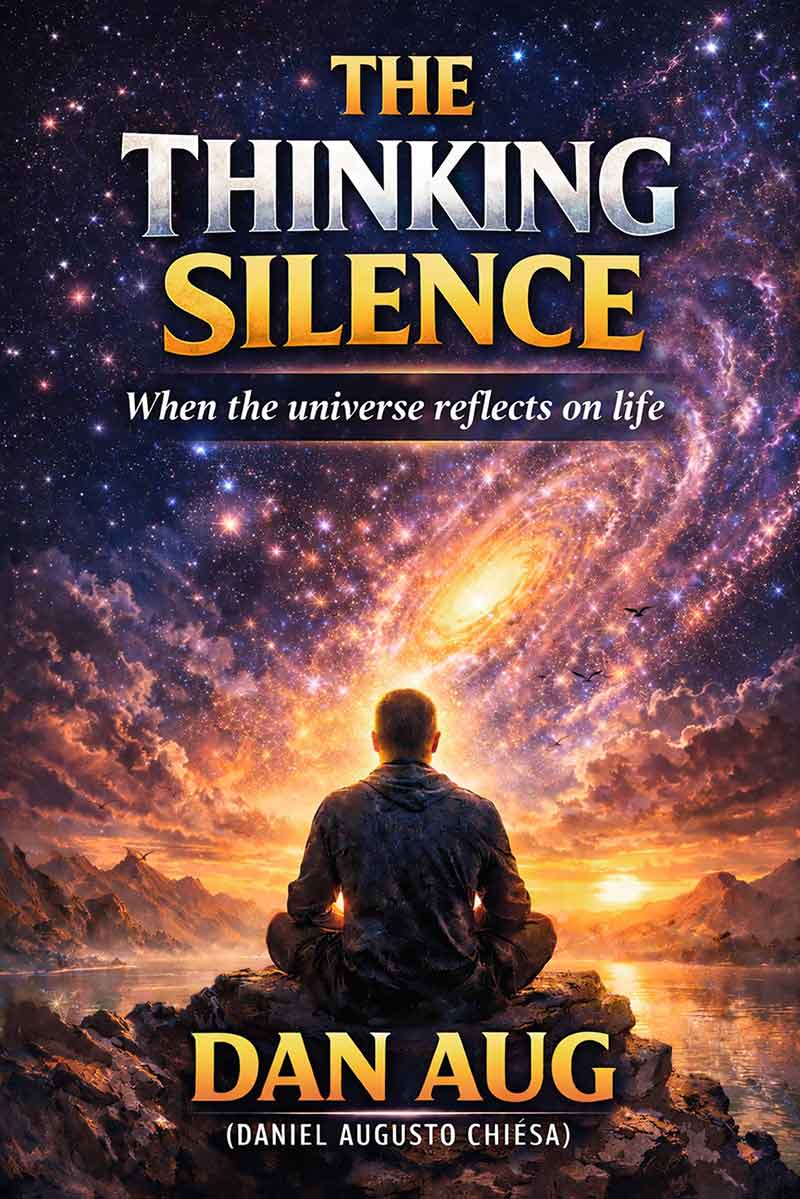
The Thinking Silence emerges not as a conventional essay, but as a structural inquiry into the nature of life itself—an attempt to redefine its scope beyond terrestrial constraints and to situate it within the broader architecture of the known universe.
In this work, DANIEL AUGUSTO CHIESA (Dan Aug) proposes a radical expansion of the concept of life, displacing it from its traditional biological framework and repositioning it as a universal phenomenon intrinsically linked to consciousness, perception, and the fabric of existence itself.
The expansion of life beyond Earth
Across its eight chapters, the essay unfolds as a progressive dismantling of anthropocentric paradigms. Life, as commonly understood, is no longer confined to organic systems or planetary conditions; rather, it is approached as a structural principle embedded within the universe.
This perspective suggests that life is not an exception, but a continuity—a manifestation that may adopt forms beyond current scientific classification. The universe ceases to be a silent container of matter and becomes instead an active field of potentiality, where existence itself may be interpreted as a form of expression.
A surgical philosophical architecture
The internal structure of The Thinking Silence is precise, almost surgical. Each chapter operates as a conceptual incision, isolating and examining fundamental aspects of existence: perception, time, matter, consciousness, and their interrelations.
Rather than offering definitive answers, the text constructs a framework of inquiry. It invites the reader—particularly those within academic, scientific and philosophical domains—to reconsider foundational assumptions about reality.
This methodological rigor positions the work within a transdisciplinary field, intersecting cosmology, philosophy of mind, metaphysics and theoretical reflection.
Consciousness as a universal axis
One of the central hypotheses developed throughout the essay is the possibility that consciousness is not an emergent property of biological complexity, but a pre-existing condition of the universe.
From this standpoint, human awareness is not the origin of consciousness, but one of its localized articulations. The implications of this inversion are profound: it reframes humanity not as the center of existence, but as a participant within a broader, possibly infinite, network of perception.
The language of silence
The title itself—The Thinking Silence—encapsulates a paradox that defines the entire work. Silence is not presented as absence, but as a state of latent cognition, a field in which meaning exists prior to articulation.
In this sense, thought does not generate reality; it reveals structures already present within it. Silence becomes the medium through which deeper layers of existence can be accessed, suggesting a form of knowledge that transcends language.
Chapter Eight: A critical vision of religions
The eighth chapter constitutes one of the most incisive and personal segments of the essay. Here, Dan Aug undertakes a critical examination of religions—not from a dismissive standpoint, but from an analytical and structural perspective.
Religions are approached as symbolic systems that historically attempted to interpret the same universal questions addressed throughout the book: origin, existence, consciousness, and purpose.
However, the text argues that these systems, over time, became institutionalized frameworks that often limited the scope of inquiry they initially sought to expand.
Rather than rejecting spirituality, the author proposes its reconfiguration—liberating it from dogmatic structures and reintegrating it into a broader, more universal understanding of existence.
Implications for science, philosophy and culture
The Thinking Silence is not confined to literary or philosophical discourse. Its implications extend into multiple domains:
- Cosmology: reconsidering the nature of life and consciousness in the universe
- Philosophy: redefining existence beyond anthropocentric models
- Science: opening conceptual pathways for new theoretical frameworks
- Culture: fostering a deeper, more unified understanding of humanity
For universities, research centers, observatories and cultural institutions, the work offers a platform for dialogue across disciplines—an intellectual bridge between empirical knowledge and existential inquiry.
A work positioned for global academic relevance
The essay’s strength lies in its ability to operate simultaneously at multiple levels: it is accessible yet profound, speculative yet structured, philosophical yet anchored in conceptual rigor.
Its positioning within global academic and cultural circuits is not incidental. The Thinking Silence addresses questions that are increasingly central to contemporary discourse: What is life? What is consciousness? What is our place within the universe?
By engaging these questions through a unique and uncompromising voice, the work establishes itself as a relevant contribution to ongoing international conversations.
Conclusion: towards a new ontology of existence
Ultimately, The Thinking Silence proposes a shift—subtle yet radical—in how existence is perceived.
It does not seek to replace existing paradigms, but to expand them. It invites a reconsideration of what we define as life, thought, and reality itself.
In doing so, the essay opens a space for a new ontology: one in which the universe is not merely observed, but understood as a dynamic, conscious structure in which humanity participates.
Within that space, silence is no longer empty. It is thinking.