TIME, a cosmological enigma
Between experience, science and the artistic construction of reality
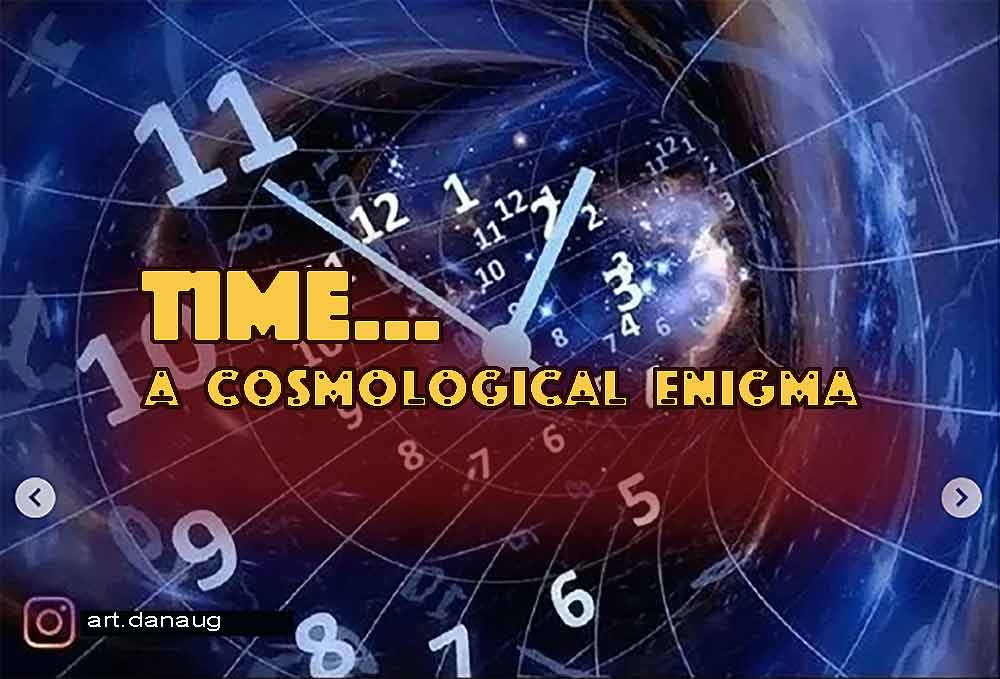
Time is perhaps the most intimate and, at the same time, the most elusive dimension of human experience. We inhabit it constantly: it structures our lives, organizes our memories and projects our expectations. Yet when we attempt to understand it in depth, time reveals itself as an extraordinarily complex, even elusive phenomenon.
Time holds a dual condition: it is something we continuously experience, yet it seems to escape any precise definition. This paradox—between familiarity and mystery—constitutes the core of the cosmological enigma of time.
Throughout history, time has been interpreted in multiple ways: as flow, as measure, as illusion, as dimension. However, advances in modern physics, together with philosophical reflection and artistic exploration, have radically transformed our understanding of its nature.
I. Time as experience and as problem
From a phenomenological perspective, time is not merely an external parameter but a lived experience. We do not perceive time as an abstract line, but as a succession of meaningful moments.
The reflection of Saint Augustine introduces a fundamental tension: we know what time is as long as we are not asked to explain it. The moment we attempt to define it, that knowledge dissolves.
Thus, time also appears as a construction of consciousness: a distension between memory (past), perception (present) and expectation (future).
II. The illusion of absolute time
For centuries, classical physics upheld the idea of absolute time. However, this conception is radically transformed with the theory of relativity.
Time ceases to be constant and universal. It depends on the observer, on velocity, and on gravity.
- Time dilates at high velocities
- Gravity affects its flow
- Not all observers share the same time
Time becomes a relational magnitude.
III. Spacetime
Relativity unifies space and time into a single structure: spacetime. Events do not occur “in” time, but are located within a four-dimensional geometry.
Each observer constructs their own temporal measure.
IV. Time in cosmology
In cosmology, time has an origin: the Big Bang. Before this event, the very concept of time loses meaning.
Time is not a stage, but an emergent property of the universe.
- Big Freeze
- Big Crunch
- Big Rip
In all cases, time appears as a contingent magnitude, not an eternal one.
V. The quantum revolution
Quantum mechanics introduces an even deeper crisis:
- Superposition of states
- Entanglement
- Indeterminacy
Time ceases to be linear. At certain levels, past and future lose their fundamental distinction.
VI. Planck time
Planck time (~5.39 × 10⁻⁴⁴ s) represents the limit of known physics.
- Spacetime loses continuity
- Theories cease to be valid
- Time becomes undefinable
It is the boundary of scientific knowledge.
VII. Art as interface
Art does not explain time: it makes it experienceable.
In works such as Dream of a Night in Giza or The Planck Time, time fragments, overlaps and reconfigures itself.
- Non-linearity
- Simultaneity
- Breakdown of continuity
Art becomes an interface between science and perception.
VIII. Time as a cosmological enigma
Time is not merely a physical dimension nor simply a perception.
It is a cosmological enigma.
A phenomenon that emerges at the intersection of:
- The structure of the universe
- The limits of knowledge
- Human experience
Conclusion
What once appeared to be the most stable foundation of reality has become one of its most uncertain aspects.
Yet this uncertainty is not a limitation, but an opening.
Perhaps, ultimately, time is not something to be defined, but something to be perceived in a different way.